|
There are over 200 "secret" routes in Connecticut:
highways with numbers above 400.
"Secret" is just an unofficial term for unsignposted state roads and state service roads.
Many of these are small auxiliary roads, or even long exit ramps.
The general public should never hear about secret routes, but they sometimes show up on maps, and a few road signs have even gone up. This page discusses some of the more interesting routes in the 500s. In the current numbering system, these are found in the north and central areas of the state. See also: selected 400's, selected 600's, selected 700's, selected 800's, selected 900's, or the complete list (400-999). |
|
| SR 500 | SR 500 is the short freeway leading north from the "Mixmaster" interchange with I-84 and Route 2 to Governor Street in East Hartford. The interchange opened in fall 1965. This was to be the start of Interstate 284, which was cancelled in 1983. |
| SR 501 | A short connector from I-84 exit 43 to Park Street in West Hartford. SR 501 was once planned to continue north to Farmington Avenue; called the "Trout Brook Connector," it would have been one of several expressway spurs to I-84 in metropolitan Hartford. To my knowledge, it has never (even in planning) been given a number other than 501. Presumably had it been built, a number under 400 would have been chosen for signage. Engineers started planning the expressway network around Hartford in the 1940s. By the early 1950s, the consensus had the major east-west expressway (now I-84) passing near Corbins Corner on the way to New Britain, well south of West Hartford Center. To serve that location, a Farmington Avenue Connector, paralleling Trout Brook Drive, was proposed. The portion of I-84 that turns directly south after exit 43, then veering west again near New Britain Avenue, is recognizable in planning maps from 1955. When Interstate 84 opened in the 1960s, a three-level interchange and a connection to Park Road were built, preparing for a future extension north. (A lack of federal funds led the state to temporarily end the highway at Park Road.) The highway was to be elevated and cross Farmington Avenue to end at Milton Street, at a cost of about $10 million. In 1968, however, the state highway department said SR 501 could no longer be built exactly as planned because the "lane design and weave patterns" were no longer acceptable for modern traffic. West Hartford's mayor and state senator discussed other changes (now that SR 501 was no longer cast in stone), including shortening the route to south of Farmington Avenue. In late 1970, open space concerns prompted officials to propose a lower profile roadway, at grade and ending at Farmington Avenue. In 1975, the state planned to extend SR 501 to Farmington Avenue. Design was already complete, and construction expected to start soon, but the environmental impact statement status was "negative, pending." At some time after that, the idea was abandoned. |
| |
| SR 502 | Silver Lane, East Hartford, and Spencer Street, Manchester, from Route 2 to US 6. |
Silver Lane follows an old Indian trail that linked a settlement at the confluence of the Hockanum and Connecticut rivers to the eastern uplands. In East Hartford, Silver Lane was formally surveyed and constructed in the early 1700s -- one of the first such roads outside the village center at Main Street. 20th century historyFor decades, Silver Lane was a signed route. From about 1926 through 1931, it was called Route 317; in 1932, it became part of a cross-state Route 101. In 1935, much of Route 101 became part of the new US 44, including Silver Lane. In 1942 or 1943, following the 1942 opening of the Charter Oak Bridge, US 6 was rerouted over the bridge and onto Silver Lane. US 44 was moved to Burnside Avenue, where US 6 had been. When the Wilbur Cross highway was extended to Vernon in 1949, US 6 was rerouted to stay on the new highway until the US 44 interchange in Manchester. After US 6 was moved, Silver Lane picked up the "secret" route number SR 810. In 1963, the numbering scheme was changed, and Silver Lane became SR 502. SR 502's original west end was Main Street (US 5) in East Hartford. When the Charter Oak Bridge was replaced in 1991, the cloverleaf interchange with Main Street was revised. Silver Lane was extended to meet Route 2 and provide access from Route 15 to Main Street. The intersection with Roberts Street (SR 518) in East Hartford has been traditionally congested. Nearby on Roberts Street is an interchange with I-84; on the other side of Silver Lane is the entrance to Pratt & Whitney, which once employed 30,000 people. In 1968, the state studied grade separating Silver Lane and Roberts Street and building an interchange, but no work was done. Lately, plans have been revived just in case Rentschler Airport and other property on Pratt & Whitney grounds are converted to retail or entertainment use. A football stadium for the University of Connecticut opened on August 30, 2003. (UConn defeated Indiana 34-10.) | |
| |
| SR 503 | Exit 46 ramps (Sisson Ave), I-84, Hartford. Once planned for a Route 189 freeway, the ramps are now in danger of being torn down. The 1999 "Hartford West" transportation plan involves some safety and flow improvements on I-84, including a "reduction in profile" of the interchange. The left exit from I-84 eastbound does not help its case, as left exits are now deprecated. In late 2000, ConnDOT initiated the West Side Access Study, examining four interchanges including Exit 46, SR 503. The favored alternative as of late 2001 is a single-point urban interchange (SPUI). For more information about the canceled 189 freeway and SR 503's role in it, see: Woods River Expressway. |
| SR 504 | Exit 45 ramps (Flatbush Ave), I-84, Hartford. Once planned for a short freeway to connect with the Berlin Turnpike near the South Meadows Expressway connector (or for route number fans, US 5/Route 15 at Route 314). See the Hartford's Proposed Freeways map. |
In the 1950s, this was planned as a Newington Avenue (Route 176) connector to the East-West Expressway (which became I-84). Studies recommended extending it to the Berlin Turnpike as stated above. Together with the planned Woods River Expressway, it would create a north-south expressway from Wethersfield to Bloomfield. In 1961, both the Woods River and Newington Avenue Connector highways were planned to be part of the relocated Route 9. In 1963, however, the state proposed SR 504 as the Cedar Ridge Connector (no number), leading from I-84 in Hartford to Route 15 in Wethersfield. The short expressway would include an interchange with a Route 71 expressway leading to New Britain. | |
Exit 45 is currently an incomplete interchange, with ramps only for I-84 WB to SR 504 (left exit) and SR 504 onto I-84 EB. The latest plans for the region include completing the interchange, providing access to points west, and moving a ramp to eliminate the left exit. Instead of creating a fully directional interchange, the state might build a diamond interchange or variant, and possibly open up surface access from the north. See the ConnDOT West Side Access Study page for updates. | |
| |
| SR 506 | This is now part of Route 9 from Route 72 to Route 175. The 10-lane section, built in 1979, was a planned Route 72/I-291 connector; the 4-lane section (killer merge) to Route 175 opened on July 17, 1986. (That section was 1 mile, $12.3 million.) When the freeway was extended to I-84 on Sept. 30, 1992, the whole thing became part of Route 9. In 1978, New Britain mayor William J. McNamara called the freeway the "road to nowhere;" the state had to keep taking down "Next Exit - Road to Nowhere" signs that cropped up on Route 72. That stretch of road is still named the Taras Shevchenko Expressway, after a Ukrainian poet and freedom fighter (who unfortunately never got to visit New Britain). |
| SR 508 | 1.82 mile exit 39 approach to (Route 4), I-84, Farmington. Once planned for Route 4 freeway connector from I-84 to a planned Route 10 freeway. The connector mainline is only about a mile long, but the official length includes 0.8 miles adjacent to I-84 eastbound. This is the stretch walled off by Jersey barrier, so that SR 508 left-hand entrance traffic doesn't cross I-84 to the right-hand Route 9 exit. |
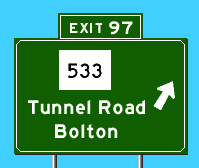
| SR 533 | Tunnel Road, Vernon. Because of a mixup, there was actually a sign on I-86 for that exit with a Route 533 marker. "What a strange number for a highway..." Sadly, it was taken down. How did Tunnel Road get its name? For a one-lane tunnel on the route, built between 1846 and 1849. The 108-foot keystone arch tunnel, the longest in the state, was built with only the help of oxen and hand tools. The arch was built by leaning stones against a temporary wooden frame. When the keystone was placed, the arch became self-supporting. The tunnel is 14 feet wide and 16 feet high at the center. For more information, see http://www.vernonct.com/tunnel.htm. |
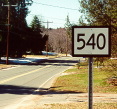
| SR 540 | The photo, at right, was contributed by a Connecticut resident who prefers not to be named. But thanks: this was quite a find! (The sign was taken down in 2004.) Another wrinkle: road signs at each end (and the AAA map) spell "Hatchett" with only one trailing T. |
| |
| SR 565 | 1.73 mi; Maple Ave and Dowd Ave; near US 44, Route 179, Collinsville - Canton. Part of it near Canton Village along the Farmington River is a state scenic byway; since the official DOT state map and other sources refer to this unsigned route as simply "Route 565," I figured I'd better tell you where it is. |
| SR 571 | The old 1.45-mile freeway section of Route 72 in Berlin/New Britain. Goes west from an incomplete interchange at the Route 9 curve, provides an interchange at Route 71, and ends at routes 71A and 372. Serves Willow Brook Park and a minor-league baseball stadium. For a few years, SR 571 was signed as part of Route 372. It's now signed from Route 9 as "To [71] [372]". |
| SR 597 | At 0.6 miles, SR 597 is not much more than a pair of long exit ramps to and from points east on Interstate 84 in Southington. Most drivers know it only as Exit 29 (Route 10, Cheshire) and a left exit at that. It opened on April 26, 1963, at a reported cost of $602,356.46. (One pictures the contractor handing the DOT back $3.54 in change.) As you exit I-84 on this connector, you can see that it was meant to continue across Route 10. This would have been a Route 10 expressway leading to New Haven. That plan was cancelled around 1974. In the late 1990s, the state planned to eliminate SR 597 entirely as part of a project to widen I-84. A successful grass-roots support to save it earned Exit 29 fame as Connecticut's "best-loved exit." |
Extending SR 597In 1963, plans were already in place for a Route 10 expressway extending from New Haven to Massachusetts. In Southington and Plainville, Route 10 would overlap with I-84. SR 597 would be the southern interchange of these expressways. The Route 10 proposal faded in the early 1970s; in 1974, a state feasibility study determined that building a Route 10 expressway south of I-84 was "not considered a prudent or acceptable alternative, considering social, economic and environmental factors." Meanwhile, the state was studying a short (2-mile) extension of SR 597 to the proposed Route 66 expressway (now I-691). A 1971 report described Routes 66 and 597 as four-lane freeways with wide medians, connected by a multidirectional interchange. Three businesses and 30 homes would be taken. The 1975 state master transportation plan also recommended extending 597 to 66, this time with ramps to and from the east only; the proposed cost was about $11.5 million. Although the Route 66 freeway was completed in 1989 as I-691, SR 597 was never extended. Save Exit 29!The state plans to widen Interstate 84 between Waterbury and Southington to six lanes, relieving congestion on an old four-lane section of the road. Construction is expected to start in 2002. The most controversial part of this otherwise well-received proposal followed from the expense needed to reconstruct the SR 597 bridge over eastbound I-84: to save costs (and eliminate a left exit), the state in 1998 planned to eliminate the exit. Local residents and businesses contested that Exit 29 worked quite well the way it was, and the alternatives took more time and diverted traffic on local roads. For a while the state stood firm on removing the exit, but in late 1998 relented. Barring future changes, Exit 29 will stay. | |
| |
| |
| SR 598 | 0.67-mile Whitehead Highway, Hartford; the "Capitol Area" freeway off I-91. Two interchanges; tunnels under the Hartford Public Library. Built on the bed of the Park River, which was put in a culvert. SR 598 was intended to be part of I-484, which would have tunneled under Bushnell Park and connected to I-84 at exit 48. The original Conland Highway, dating back to late 1945, included what is now I-91 south of it the Charter Oak Bridge, and Route 15 from there to the Berlin Turnpike. It was originally called the South Meadows Expressway, and part of US 5 and Route 9. |