Fictional interchanges
Here are some interchange designs that I had not seen used in real life — though now at least two of them have been built.Spupclo (Single-Point Urban Partial Cloverleaf)
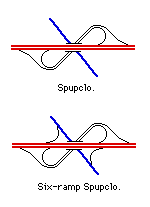
You've heard about how the diamond interchange design can be changed to a SPUI, (single point urban interchange) by locating the ramp termini to meet at one point, usually directly above or below the freeway.
You can also do this with a partial cloverleaf with loops in opposite quadrants (as pictured). This Single-Point Urban Partial Cloverleaf ("Spupclo") favors gradual left-turning movements by providing loops for them. To improve a Spupclo even further, add ramps in the vacant quadrants (surface street to freeway) to make a six-ramp interchange. The two added ramps relieve left-turning traffic from the surface street at the main intersection.
One problem with the Spupclo is the disorienting outcome of using an exit ramp and proceeding straight through the single-point intersection: the road becomes an entrance ramp in the opposite direction. The six-ramp Spupclo with appropriate channelization avoids this.
... and there is now a Spupclo in real life, at CA 210 and E. Baseline Road in Claremont, California (Google Maps).
Windmill, DPUI, and Looped Windmill
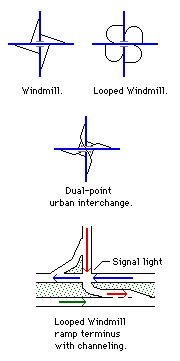
The windmill serves two surface streets with a grade separation. All four directions can access the other roadway by a right-hand exit ramp, with stop sign or traffic signal at the terminus. All traffic stopped to make a left turn waits on the ramp instead of the main road, decreasing the chance of rear-end accidents.
In a manner similar to the volleyball interchange, left-turning movements are deferred to the road at the end of the exit ramp. Also, note that the windmill has four exit ramps and no entrance ramps, but still provides complete access.
However, for each road there are two intersection points that require both directions of mainline traffic to stop for left-turning cross traffic. Also, there can be the same problem of traffic "stacking up" between those intersections, just as with a conventional diamond interchange. How can this be remedied?
One method is to bring each pair of ramps terminating on a roadway to meet at a single point, just like a SPUI. However, there would be two points (one for each road), not one, yielding a Dual-Point Urban Interchange. I haven't seen one of these.
A better solution (comparatively) is the Looped Windmill, where the four diagonal ramps are replaced by four loops. With appropriate channelization (shown), the only stopping points are at the loop terminus (left turn) and on the roadway entering the interchange area (straight).
I never expected any of these interchanges would pass the "silly test" and be built, but there is a real-life windmill in Jackson County, Ohio, at the junction of US 35 and OH 32/124 (see Google Maps). Thanks to Dan "SPUI" Moraseski for this one.
Paperclip

Use the Paperclip for access from a freeway to a parallel road close by. Unlike a trumpet or diamond with short connector to the surface street, the Paperclip has no weaving conflicts and only one four-way intersection, for greater capacity.
The disadvantage: the Paperclip is more costly, with an additional overpass and right-of-way needed on the opposite side of the surface street. But your drivers will thank you.
Links
- Interchanges
- Glossary
- Culture: interchanges in movies, computer games, etc.
- Diamond and other 4-ramp designs
- Six-ramp partial cloverleaf
- Cloverleaf
- Trumpet and other 3-way interchanges
- Stack and other heavy-duty 4-way interchanges
- Volleyball: an odd 3-level 4-way treatment
- SPUI: Single-Point Urban Interchange
- Oddities: Some strange or fictional interchanges