The Full Cloverleaf
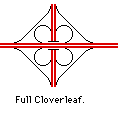
The classic cloverleaf allows "non-stop" full access between two busy roads. Traffic merges and weaves, but does not cross at-grade; unless the interchange is too congested, no stopping is required. The colloquial "cloverleaf" is the same as the more technical "full cloverleaf", as you can omit ramps to get a partial one.
Typically a cloverleaf is used where a freeway intersects a busy surface street, though many older freeway-freeway interchanges are also cloverleafs. As we'll see, the full cloverleaf is not considered as applicable in some situations now as it might have been a few decades ago; in several places cloverleafs have been replaced with either signalized interchanges or higher-capacity directional interchanges with flyovers.
Design Notes
The cloverleaf is (on paper) the simplest way to connect two freeways. The only bridges required are to separate the two roadways. If land is expensive, so too can be the cloverleaf, which becomes a choice between tight turning radii (and lower design speed) or lots of consumed land. You'll notice that most loop ramps are banked to counteract centrifugal forces.A small advantage that "falls out of the design" is the "second chance:" if you miss the first ramp to the right, you can simply take three loops in a row to get back on track. (I've also used two loops of a cloverleaf to make a U-turn.)
Weaving
A disadvantage to the plain cloverleaf is the "weaving" process, where drivers exiting one loop have to merge and cross other drivers entering the next one. Weaving, which causes bottlenecks and accidents, is the primary reason cloverleafs are now deprecated in designs for new or revamped interchanges. In several instances, California has been replacing old full cloverleafs with 6-ramp partial cloverleafs.
C/D roads
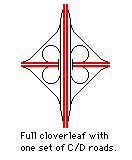
One way to improve a cloverleaf is to add collector/distributor (C/D) roads, which run parallel to the freeway and isolate it from the weaving action at the loops. Traffic exits the freeway onto the C/D road, and then can decide which direction to take. Likewise, onramps from both directions of the other road merge together first, then merge onto the primary road. The weaving problem still exists, but has been moved to a lighter-traffic side road; and the freeway now has two ramps (entrance and exit) to deal with instead of four. Where two freeways intersect, each one may have C/D roads.
Variations
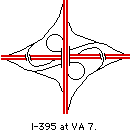
Another modification (shown), at the I-395/King St (VA 7) interchange in Alexandria, unrolls two of the loops to remove the weaving action and simplify the interface (in each direction, the driver first chooses to get to the other road, then chooses which direction (e.g. north or south) to take. The remaining two loops could be unrolled as well, creating a petal-like arrangement I've seen called a Catherine Wheel. Topologists (in the mathematical sense) will see how ramps can be stretched, flipped, moved and so on, without changing the basic function of the interchange.
Another variation (not pictured yet) replaces two diagonally opposing loops with semidirectional flyovers, creating a half-cloverleaf half-stack interchange. Lacking a catchy name for this (Caltrans calls it the "Type F-3"), fellow roadgeek Nathan Perry arrived at the name "Cloverstack." Since the two loops in a cloverstack are diagonally opposite from each other, there is no weaving.
History
The first cloverleaf opened in Woodbridge Township, New Jersey (quite the surprise) in 1929, at the junction of Routes 4 and 25. This is now the intersection of US 1/9 and NJ 35, and as of about 2004, the interchange is no longer a cloverleaf. (Fittingly, an adjacent cemetery is named Cloverleaf Cemetery.)
The interchange was under consideration for the National Register of Historic Places, but was declined, primarily because of the many safety and capacity-related alterations to it over the years: "widening and curb replacements for both roadways, revised geometry for one ramp, placement of a center barrier on Rt. US 1 & 9, removal of bridge pilasters, and the addition of modern lights and guide rails." In the end, for safety, three of the loop ramps were removed.
Thanks to Raymond C. Martin for this information.
Links
- Interchanges
- Glossary
- Culture: interchanges in movies, computer games, etc.
- Diamond and other 4-ramp designs
- Six-ramp partial cloverleaf
- Cloverleaf
- Trumpet and other 3-way interchanges
- Stack and other heavy-duty 4-way interchanges
- Volleyball: an odd 3-level 4-way treatment
- SPUI: Single-Point Urban Interchange
- Oddities: Some strange or fictional interchanges