MATR Technical Info
It would be nice not to have to care about MATR's representation of the road system, but the grid model it uses will affect your work in several ways.
Pulau Acak is divided into a grid of 0.2-mile squares. Each square is either underwater or part of a town. Land squares may also contain one intersection (see below).
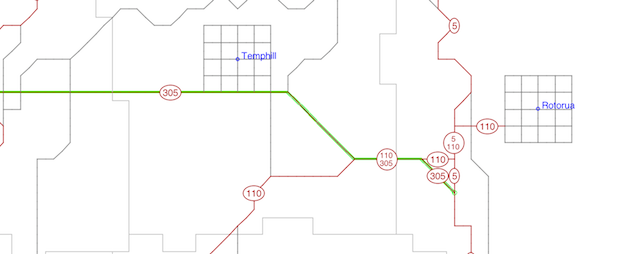
Roads can enter a square in any of eight directions (at 45 degree angles), but some simplifying assumptions restrict the types of intersections you can create (see figure). Each segment of road can have up to two route numbers and one street name associated with it (or nothing at all).
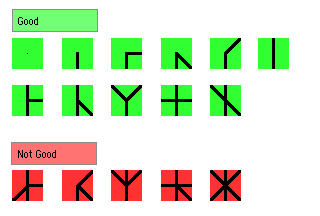
Above are all valid and some invalid intersection types in Me and The Roads. Any reflection (flip) or rotation of the valid ones is also valid. In general, you can't have five- to eight-way intersections, bend in the middle of a four-way, or meet on the inside "elbow" of a sharp curve.
Terms
In MATR, some common terms have more precise meanings to help you with the documentation.- A segment is one section of road linking two squares. It's 0.2 miles long if vertical or horizontal, or 0.28 miles if diagonal.
- An intersection is one or more road segments meeting in a square. Such things as a dead end, or a road passing straight through, also count (trivially) as intersections.
- Pavement is a segment of road without regard to its route number or street name. Pavement has a type (dirt, 2 lane undivided, freeway, etc).
- A route is a numbered highway. Think of a route as overlaying a series of segments of pavement. Two routes can overlap (share the same pavement).
- A street is a named section of pavement. It may also share a route number, but doesn't have to.