Outsourced?
I spent a week in Noida, India (near Delhi) on business. Sightseeing was limited to the Taj Mahal, only 200 km distant, on National Highway 2. Here are some photos and observations of roadgeekly interest.
Driving in the area takes patience and assertiveness. Use of the horn, considered rude in many places, is polite here: it lets others around know you are approaching. Some rickshaw bumper stickers advertise CCIE and CCNA certification courses. Somewhere Tom Friedman is smiling.
There is no rail transit yet into Noida, but work is underway. The elevated line follows the median of a local four-lane street. As in Britain, Singapore, Japan, and many other countries, Indians drive on the left.
Curbs are higher than in the United States: often 8 to 12 inches. Accessibility for wheelchairs is basically nonexistent. Here, a fence in the median blocks what looks like a crosswalk.
I'm not sure if this is a "ghost ramp" or still being worked on.
There was a small toll between central Noida and National Highway 2. Despite appearances, this is an operating booth, and a toll taker inside accepted our payment.
Almost every truck has a colorful custom paint job and some variant of a reminder to blow your horn if intending to pass.
I saw no route markers in Delhi or Noida. Our first marker, for National Highway 2, appeared at a police checkpoint in Faridabad.
To the right is a mile marker, but we'll get a better look at one later.
NH-2 has two toll barriers on the way to Agra, 100 km apart. A rupee is about 40 to a dollar, or 30 to a dollar if buying from Thomas Cook (and 45 when selling back).
The tolls are put to good use: in general, NH-2 is nicely maintained, both in median landscaping and pavement. It is four lanes divided for its entire length between Delhi and Agra, but all intersections are at grade.
A heck of a lot of politicians and VIPs get to use NH-2 for free. Sorry for the poor legibility. There's another milepost at lower right.
I think this is in Palwal. Most populated sections of NH-2 looked like this.
An administration building of the NHAI, the National Highways Authority of India.
A list of the three most beautiful sites I saw in India:
A political protest march, leading from Agra to Delhi, closed several miles of the northbound lanes of NH-2 south of Mathura. Traffic pushed its way into the southbound lanes, without the help of traffic police. The result was about what you'd expect. We spent about 45 minutes not moving.
Even though NH-2 was fairly well marked with trailblazers and mileposts, all intersection signs were marked with destinations only. Almost all signs were in English and Hindi.
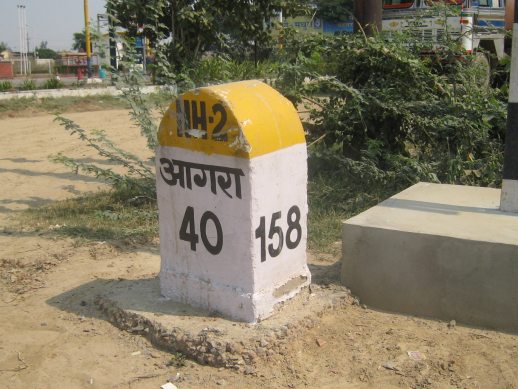
At nearly every kilometer were mileposts showing the highway number and distance to next major city. Some were bilingual, and some were either English or Hindi. We'll get a closer look at one below.
Locate this milepost, and you'll find out where I had lunch on the way back to Delhi. It was within walking distance of the parking lot, offering a safe way to get some good closeups.
NH-2 is the highway; 40 km to Agra, and 158 km from Delhi. I'm guessing the last number resets as NH-2 crosses major cities, since it doesn't end in Delhi.
Interesting: a very similar type of milepost (photo) is used in France. (Linked page and photo by Chris Marshall, CBRD.)
A typical urban street scene in Agra. Most arterial roads I saw were four lanes and divided. Turn lane pockets do exist, but were scarce.
Signs with street names were rare. I didn't see any in Noida. This sign in Delhi announces two arterial streets. "Marg" means path or way.
No road stuff here. Sorry.